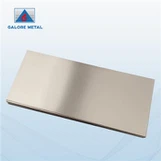
As a supplier of Gr7 Titanium Sheet, I've had numerous interactions with clients who are intrigued by its properties. Gr7 Titanium Sheet, also known as Ti-0.2Pd, is a titanium alloy with palladium added to enhance its corrosion resistance, especially in reducing acid environments. It's widely used in various industries such as chemical processing, marine, and architecture. However, like any material, it has its disadvantages. In this blog, I'll delve into the drawbacks of Gr7 Titanium Sheet to provide a comprehensive understanding for potential buyers.
High Cost
One of the most significant disadvantages of Gr7 Titanium Sheet is its high cost. Titanium, in general, is more expensive than many other metals due to its complex extraction and processing methods. The addition of palladium in Gr7 further drives up the price. Palladium is a precious metal, and its inclusion in the alloy increases the raw material cost. Moreover, the manufacturing process of Gr7 Titanium Sheet is intricate and requires specialized equipment and skilled labor, which also contribute to the high price tag.
For small - scale projects or budget - constrained applications, the high cost of Gr7 Titanium Sheet can be a major deterrent. Clients may opt for alternative materials that offer similar properties at a lower cost. For example, stainless steel is a more economical choice in some cases, although it may not have the same level of corrosion resistance as Gr7 Titanium Sheet.
Difficulty in Machining
Gr7 Titanium Sheet is notoriously difficult to machine. Titanium alloys have low thermal conductivity, which means that during machining, heat generated at the cutting edge is not dissipated quickly. This results in high temperatures at the cutting tool, leading to rapid tool wear. The high strength and low elastic modulus of Gr7 Titanium Sheet also cause the material to spring back during machining, making it challenging to achieve precise dimensions.
Specialized cutting tools and machining techniques are required to work with Gr7 Titanium Sheet. Carbide tools with specific coatings are often used to withstand the high temperatures and pressures during machining. Additionally, slow cutting speeds and high feed rates are typically employed to reduce heat generation. These specialized requirements increase the machining time and cost, further adding to the overall expense of using Gr7 Titanium Sheet.
Limited Weldability
Welding Gr7 Titanium Sheet presents several challenges. Titanium is highly reactive to oxygen, nitrogen, and hydrogen at elevated temperatures. During the welding process, if the material is exposed to these elements, it can form brittle compounds that reduce the mechanical properties of the weld joint. Therefore, welding Gr7 Titanium Sheet requires a controlled environment, usually an inert gas shield such as argon, to prevent contamination.
Even with proper shielding, achieving high - quality welds in Gr7 Titanium Sheet can be difficult. The presence of palladium in the alloy can also affect the welding process. Palladium can cause cracking and porosity in the weld, especially if the welding parameters are not carefully controlled. Welders need to have extensive experience and training to weld Gr7 Titanium Sheet successfully, which can limit its use in applications that require extensive welding.
Susceptibility to Galling
Galling is a form of wear that occurs when two metal surfaces in contact slide against each other under high pressure. Gr7 Titanium Sheet is susceptible to galling, especially when in contact with other titanium alloys or hard metals. Galling can lead to surface damage, increased friction, and ultimately, failure of the component.
To prevent galling, special lubricants or surface treatments are often required. However, these additional steps add to the cost and complexity of using Gr7 Titanium Sheet. In applications where metal - to - metal contact is common, such as in mechanical joints, the susceptibility to galling can be a significant drawback.
Environmental Concerns
The extraction and processing of titanium, including Gr7 Titanium Sheet, have environmental impacts. The mining of titanium ore involves large - scale excavation, which can lead to habitat destruction, soil erosion, and water pollution. The chemical processes used to extract and refine titanium also consume a significant amount of energy and produce waste products that need to be properly managed.
Moreover, the disposal of Gr7 Titanium Sheet at the end of its life cycle can be a challenge. Titanium is not easily recyclable compared to some other metals, and the recycling process requires specialized facilities and technologies. As environmental regulations become more stringent, these environmental concerns may become a more significant factor for clients when choosing materials.
Comparison with Other Titanium Products
When considering the disadvantages of Gr7 Titanium Sheet, it's useful to compare it with other titanium products. For example, the NiTi Alloy Sheet has unique shape - memory and super - elastic properties, which are not found in Gr7 Titanium Sheet. NiTi Alloy Sheet is also relatively easier to form and shape, although it may not have the same level of corrosion resistance in certain environments.
The Gr5 Ti6Al4v Titanium Alloy Sheet is one of the most widely used titanium alloys. It has high strength - to - weight ratio and good weldability compared to Gr7 Titanium Sheet. However, Gr5 may not have the same level of corrosion resistance in reducing acid environments as Gr7.
The Gr1 Titanium Foil Strip is a pure titanium product with excellent formability and corrosion resistance in some environments. It is much softer than Gr7 Titanium Sheet, which makes it easier to machine but may not be suitable for high - strength applications.
Conclusion
Despite its many advantages, Gr7 Titanium Sheet has several notable disadvantages, including high cost, difficulty in machining, limited weldability, susceptibility to galling, and environmental concerns. These drawbacks need to be carefully considered when choosing materials for a particular application.
However, in applications where its unique properties, such as excellent corrosion resistance in reducing acid environments, are essential, the benefits of using Gr7 Titanium Sheet may outweigh the disadvantages. As a supplier, I'm committed to providing clients with comprehensive information about Gr7 Titanium Sheet so that they can make informed decisions.
If you're considering using Gr7 Titanium Sheet for your project or have any questions about its properties and limitations, I encourage you to contact me for a detailed discussion. We can explore whether Gr7 Titanium Sheet is the right choice for your specific needs and discuss potential solutions to overcome its disadvantages.


References
- "Titanium and Titanium Alloys: Fundamentals and Applications" by John C. Williams
- "Corrosion Resistance of Titanium Alloys" by various authors in the Journal of Materials Science and Technology
- "Machining of Titanium Alloys: Challenges and Solutions" by research papers in the International Journal of Machine Tools and Manufacture